

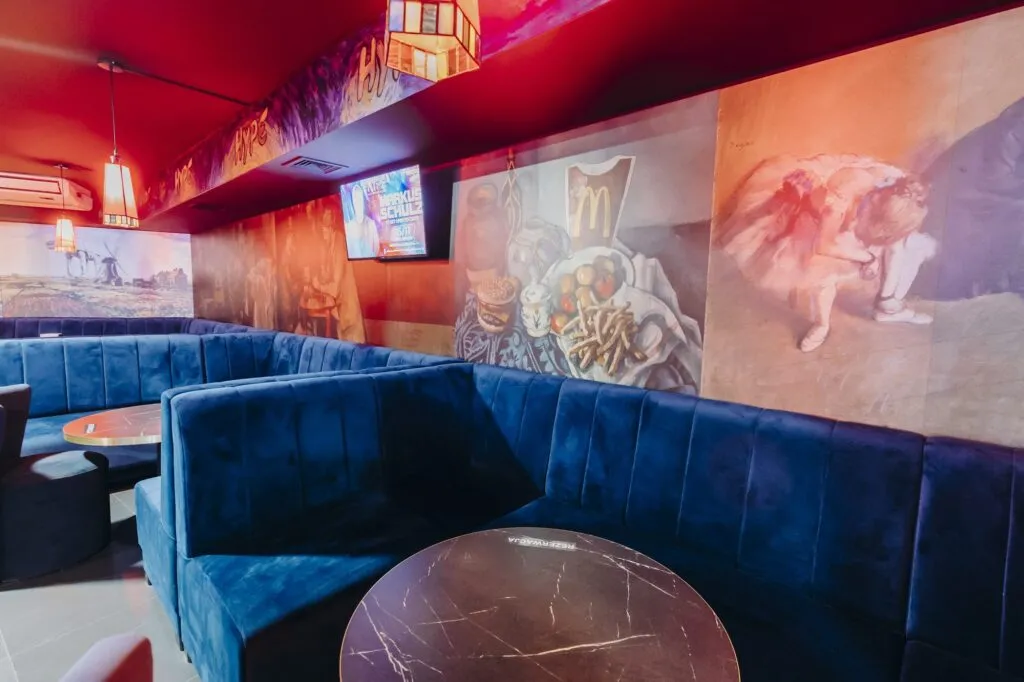
The question of how long a piece of furniture lasts usually comes up only when one sofa starts to look worn against the rest of the venue. How long the piece actually holds up has less to do with the piece itself than with how it is used and cleaned day to day.
What you can realistically expect
A properly chosen fabric and a foam with raised density, meant for contract use, hold up in an ordinary serving venue for years of heavy use, without the shape or the colour visibly giving way.
What shortens that time most is not the number of guests. It is the way the piece is cleaned. Chemicals that are too strong and dry scrubbing break the fibres down faster than the sitting does.
Three parts running on their own clocks
Durability is spread across three parts, and none of them wears at the same rate as the others.
| Part | What it does | How long it stands |
|---|---|---|
| Frame | the skeleton, and what decides whether the piece can be refurbished later | a decade or more under hard use |
| Foam | carries the comfort and keeps the shape | many years, given a density meant for contract use |
| Fabric | the only part in constant contact with guests and cleaning | wears out first |
The order is always the same: first the fabric, then the construction. So it is worth asking about all three parts separately, instead of asking for one number of years.
Eight years in a night club: what gave way and what did not
The hardest test our furniture has been through stood in Energy2000 in Katowice in Poland. In 2016 the club ordered more than 200 linear metres of BOX I from us.
A night club is the toughest environment an upholstered piece can land in: full house every weekend, sitting down and standing up all night, spillage and hours of cleaning after closing. Eight years later the customer got in touch to ask about new furniture. Before we proposed anything, we went through the sofas together: the frame and the foam were in good condition, and the years showed purely on the fabric.
Instead of new furniture we refurbished the old and recovered it in a fabric that survives more than 100 000 Martindale. These are tougher conditions than in a restaurant or a hotel, so the example shows well where the limit of wear actually lies.
How to clean without shortening the life
Regular, gentle cleaning as you go extends the life of the fabric more than a thorough clean a couple of times a year does. Vacuuming and wiping with a damp cloth and a mild product is enough in most venues.
Deal with stains immediately, before they soak into the fabric. The longer they sit, the harder they are to remove without leaving a shadow. Cleaning products are chosen for the particular cover, so ask about them when you order: different types of fabric need different treatment, even when they look alike.
The underrated cause of damage: what stands on the edge of the table
The most common accidental damage does not come from use, but from what stands right beside it. Tea lights, hot dishes and metal decorations set close against the edge of the seat ruin the fabric in spots, exactly where no abrasion test measures anything at all.
The choice of material can decide the whole lifespan. At Naleśnikarnia 2.0 in Bytom we deliberately moved away from black faux leather, and there we explain why.
Ask about this before you order
Ask about the density of the foam, how the frame is built, and how many Martindale the fabric survives. Every fabric we offer for serving venues survives at least 40 000, and most of the range sits above 100 000.
If the longest possible life is what matters most to you, say in the conversation how many hours a day the piece is in use and how often it is cleaned. That is what we choose the fabric from: 968 27 586.
Mariusz Wolski · owner of KAIZEN sp. z o.o. · in the furniture trade since 2005