

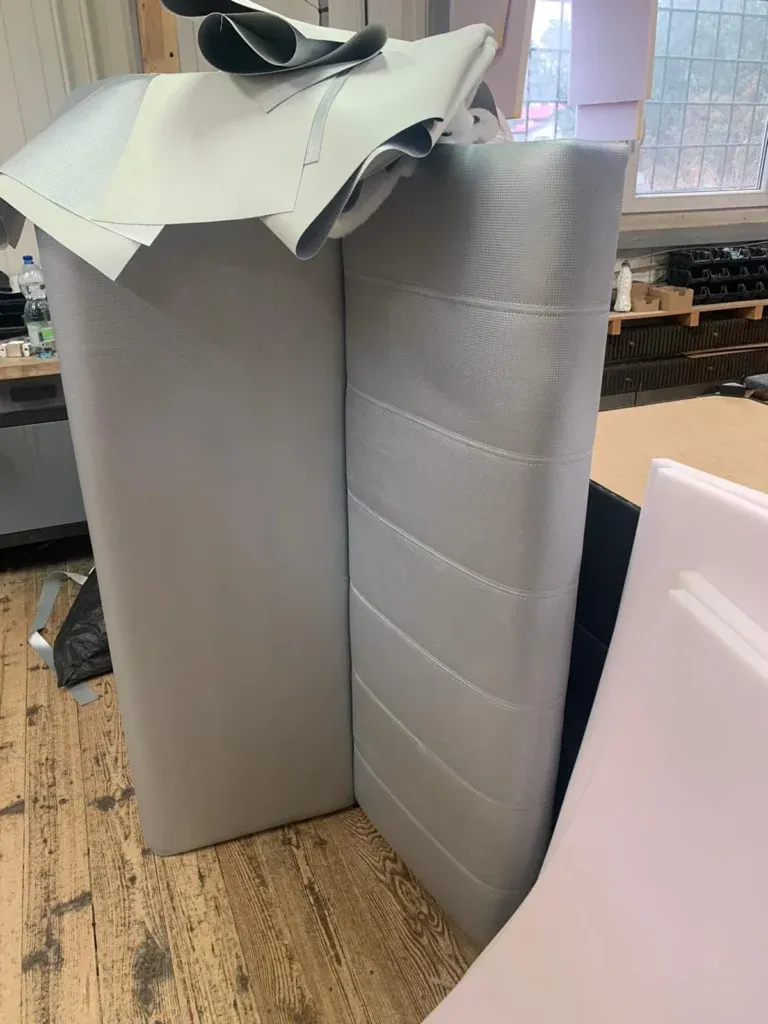
When a hotel, a club or a restaurant is getting new furniture made to measure, the first questions are usually about looks, colour and lead time. The question that in practice decides whether the purchase pays comes up less often: how long will the furniture stand daily operation? You see that answer only after a few years, not on the day the delivery arrives.
Why durability counts for more than the first impression
A piece in a serving venue works entirely differently from a piece at home. Guests sit down and stand up dozens of times a day, drinks are spilt, and the cover is cleaned regularly, sometimes with strong products.
Furniture that looks good in a photo but loses its shape after two years costs more in the end than a more expensive model that stands for ten. If you are fitting out several venues at once, you see the difference in the budget straight away, because the replacement is multiplied by the number of rooms.
Three parts, three entirely different lifespans
The durability of an upholstered piece is spread across three parts, and they do not wear anything like equally.
The frame is the skeleton. If it is solidly built, in the right materials and with the right joints, it survives a decade or more of hard use without giving way. It is the frame that decides whether the piece can be refurbished later at all, or whether everything has to be replaced.
The foam decides the comfort and how long the piece keeps its shape. Cheap foam loses its spring within months. Properly chosen foam survives years of heavy use.
The fabric wears out first, simply because it is the only part in constant contact with the guests and with the cleaning products. Every fabric we offer for serving venues survives at least 40 000 Martindale, and most of the range sits above 100 000.
The way the parts are joined counts too, that is, whether the frame is glued, screwed or mortised. On top of that come the seams, because weak seams give way exactly where guests sit down most often. With us every single part goes through a check before it leaves the workshop.
More than 200 metres at Energy2000, eight years on
In 2016, during a refurbishment of the venue, the night club Energy2000 in Katowice in Poland ordered more than 200 linear metres of BOX I from us. This is a night club, so the furniture has stood in conditions no sofa in a hotel or a restaurant comes close to.
Eight years later the customer got in touch again to ask about new furniture. Before we proposed anything at all, we went through the sofas together with them. The frame and the foam were in good condition, and eight years of operation showed purely on the fabric. The layout worked fine as it was, so there was no reason to change it.
What a cover looks like after a few years of club use you can also see at Klub 7 Nebo in Brno, where not only the sofas are upholstered, but the walls and the staircase too. The other extreme is decorative fabrics: at Cafe Beluga in Bonn we chose velour, which in a café works to an entirely different rhythm from faux leather in a night venue.
In production since 2005, without a single warranty claim
Since 2005 we have produced upholstered furniture without having had a single warranty claim or complaint. We write that as information from the workshop, not as a marketing phrase: with more than 50 projects a year for hotels, restaurants and nightlife venues, this is a figure any of those customers can confirm in a phone call.
The reason is the same as the eight years of BOX I in the night club. A construction drawn for hard use does not fail after one season, and a fabric chosen from the actual load in the venue does not wear faster than the customer expects.
A prototype before production, so a mistake never gets expensive
Before we sew up a whole venue, you get to see and try a prototype. The order of work is always the same, and we run it on every hospitality project.
| Step | What happens |
|---|---|
| 1 | a conversation about the layout, the number of seats and the character of the venue |
| 2 | proposed models and fabric samples, chosen for colour, texture and abrasion resistance |
| 3 | a prototype you see and try in your own space |
| 4 | once the prototype is approved, we start production |
The reason is prosaic. A fabric colour on a screen looks different from the same colour in the light of that particular room, at a given time of day and under a given light. The prototype also lets you feel the comfort of the seat and the height of the back beside the furniture that already stands there.
That is how we worked at Restbotanica in Katowice, where we started with samples and prototypes, and only then made PARIS to measure and the curved version of it. This takes longer than ordering a finished model, but it takes the risk of a mistake across the whole venue away from you as the owner.
How to judge a furniture maker before you order
Ask outright about four things: what the frame is built from, what foam goes into the seats, how many Martindale the fabric survives, and whether the maker has experience with furniture standing in heavy guest traffic. If you get a vague answer about foam or frame, that is a sign the construction was not drawn to stand for many years.
The second good sign is projects from a few years back, described as they work today, and not only fresh photos from installation day. A photo taken right after delivery says little about durability. It is contact with the customer a few years later that shows whether the investment paid off.
Ask too whether the maker gets in touch on their own after a few years, or whether the connection ends the day the lorry drives off.
Where to go from here
Tell us how many hours a day the piece is in use, how often it is cleaned, and whether the venue has certification requirements. From those three things we choose the foam and the fabric, before we even start talking about colour.
Daily care can extend the life of a fabric more than a more expensive cover does. We have put that together in a separate guide on how long a restaurant sofa lasts and how to care for it. Call us for a quotation: 968 27 586.
Mariusz Wolski · owner of KAIZEN sp. z o.o. · in the furniture trade since 2005